Most Dental Marketing Is Optimizing the Wrong Thing
Practices celebrate lead counts. Agencies report on them. Dashboards are built around them. Entire marketing strategies get made and unmade based on a number that has almost nothing to do with whether a practice actually grew.

Most dental marketing agencies are measuring the wrong thing.
And the crazy part? Everyone just accepts it.
Practices celebrate lead counts. Agencies report on them. Dashboards are built around them. Entire marketing strategies get made and unmade based on a number that has almost nothing to do with whether a practice actually grew.
A lead is not a patient.
A lead is someone who raised their hand. What happens after that is what matters. Do they book? Do they show up? Do they accept treatment? How much production do they generate?
If you can't answer those questions, you're not measuring marketing performance. You're measuring interest. And interest doesn't pay the bills.
The Lead Illusion
Imagine two campaigns running at your practice at the same time.
Campaign A generates 50 leads.
Campaign B generates 25 leads.
If you're only looking at lead volume, Campaign A wins. You'd probably increase its budget. You'd probably cut Campaign B.
But what if Campaign B produced twice the treatment revenue?
Suddenly the entire picture flips.
This happens all the time. We've seen campaigns that flood a practice with inquiries but generate almost no treatment. We've seen campaigns with half the leads that produce the highest-value cases in the building.
The problem is most practices never see that difference because their marketing data is completely disconnected from their Practice Management System.
So decisions get made on incomplete information. Budgets shift. Campaigns get cut.
All based on a metric that was never tied to production in the first place.
Flying Blind
Before we built our PMS Integration, diagnosing campaign performance meant piecing together clues from a dozen different places.
Lead numbers from the CRM. Call recordings. Notes from the front desk. Gut feelings from the doctor.
There was no single view that connected marketing activity to actual treatment outcomes. You could see that something was happening. You just couldn't see clearly enough to know what, or respond fast enough to do anything about it.
We were managing campaigns without the most important data in the room.
That had to change.
What We Built Instead
We built a direct connection between your marketing and your PMS.
Every lead. Every appointment. Every new patient. Every dollar of production. One dashboard. One number that actually matters: ROI.
Here's what it looks like.
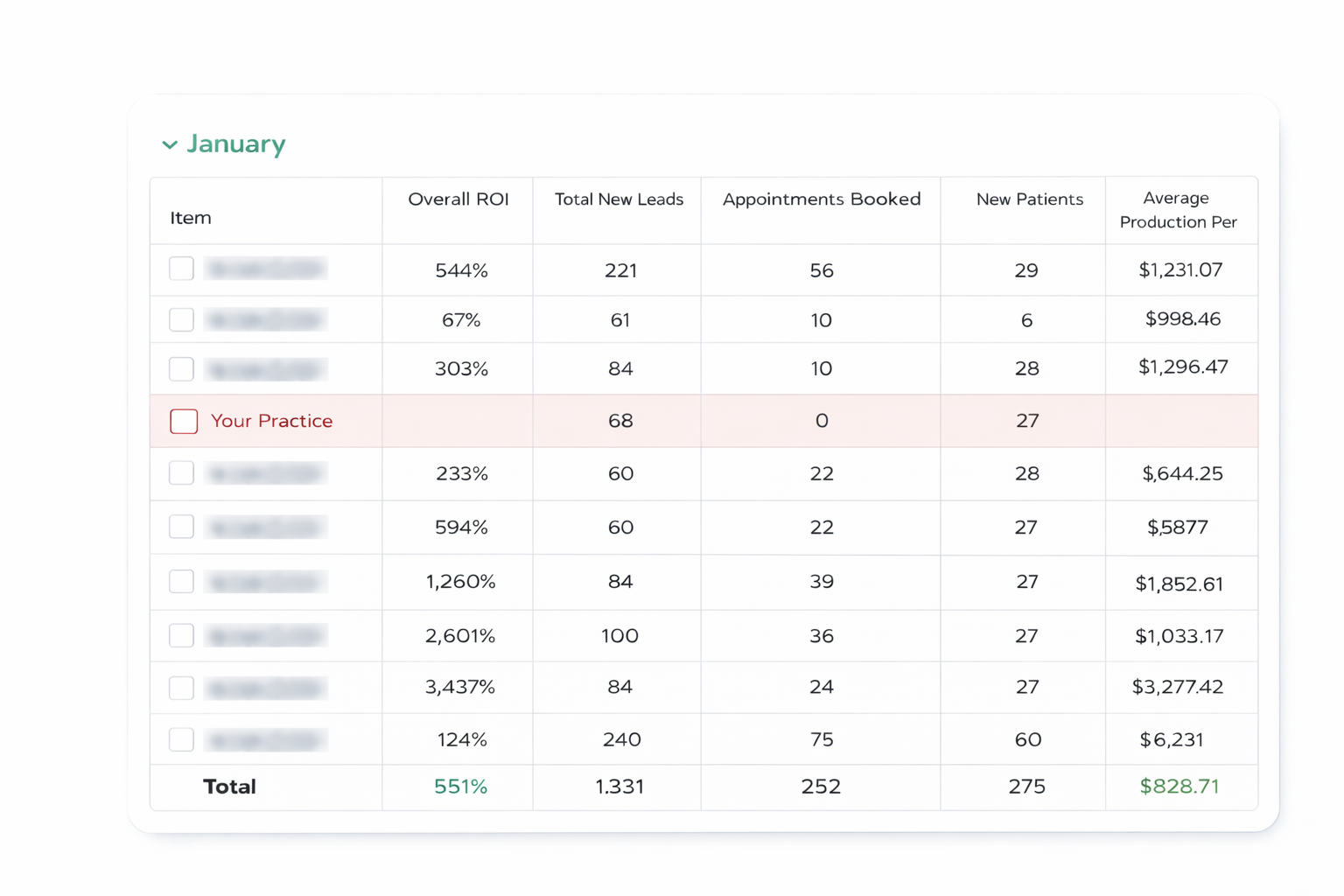
See the row that says "Your Practice"?
68 leads. 27 new patients. Zero appointments tracked. No ROI calculated.
That's what an unconnected account looks like. We can see activity happening. We just can't tell you if it's working.
Now look at every other row on that same dashboard.
544% ROI. 1,260% ROI. 2,601% ROI. 3,437% ROI.
Those are real numbers from real practices we work with — because they connected their data and let us see the full picture.
The difference between "Your Practice" and those numbers isn't better marketing.
It's visibility.
ROI by Channel — and Why It Changes Everything
Once you can see production data, you stop asking "which channel generates the most leads" and start asking "which channel generates the most revenue."
Those are very different questions. And the answers are almost never the same.
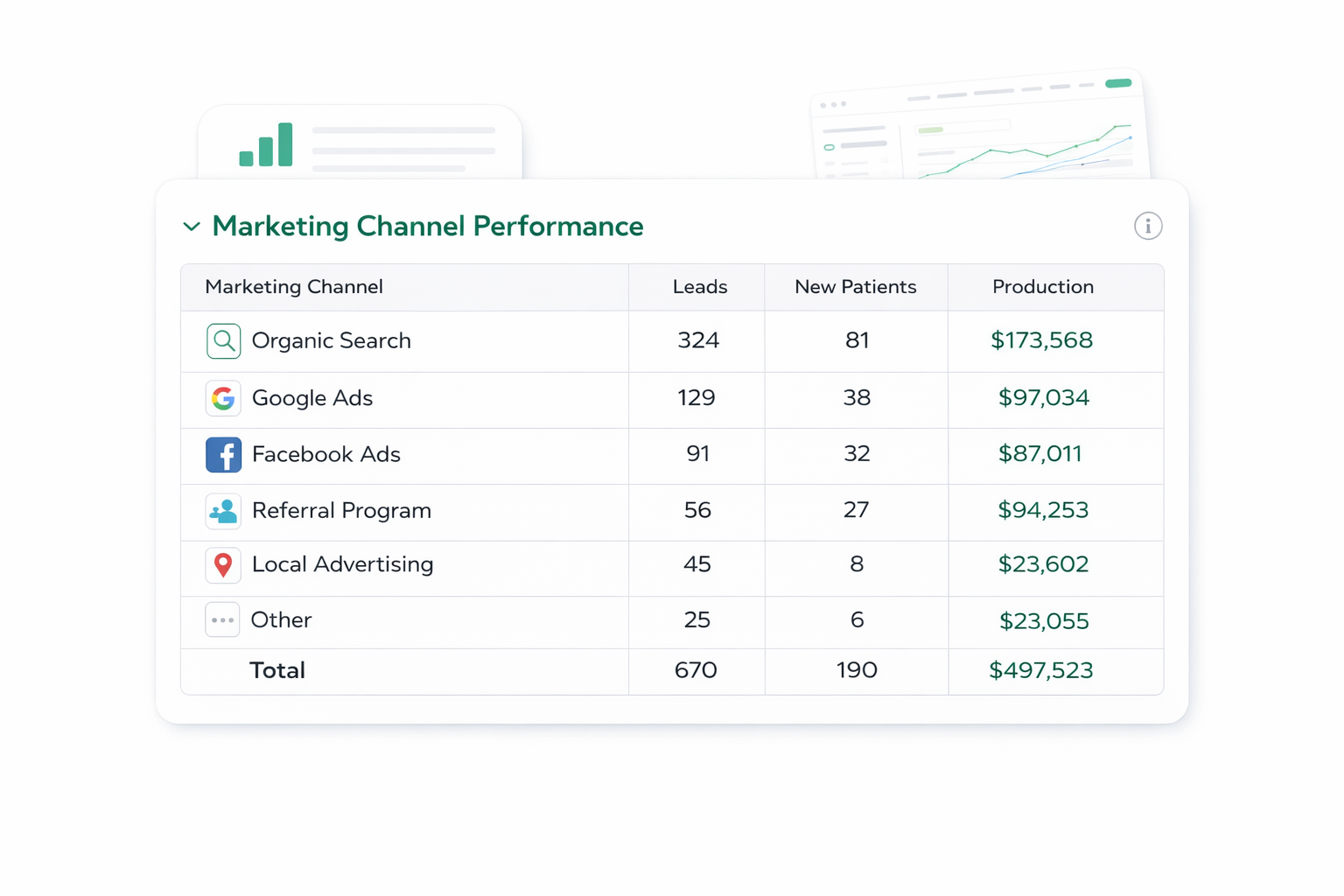
Look at that breakdown.
Organic Search: 324 leads. $173,568 in production.
Referral Program: 56 leads. $94,253 in production.
Facebook Ads: 91 leads. $87,011 in production.
Now do the math on production per lead.
The Referral Program is generating nearly double the revenue per lead compared to Facebook. If you were making budget decisions based on lead volume alone, you'd have it completely backwards. You'd be feeding Facebook and ignoring the channel quietly generating your highest-value patients.
With channel-level ROI, every dollar you spend has an accountable outcome. You're not optimizing for activity anymore. You're optimizing for revenue.
The Part Nobody Talks About: Optimizing Paid Ads for Patients, Not Leads
This is where it gets really interesting — and most people don't realize this is even possible.
When you run Google Ads or Facebook Ads, the platform's algorithm has one job: find more people like the ones who converted.
The question is: converted into what?
Right now, for most dental practices, the algorithm is trained on leads. Someone fills out a form. Someone calls. That's the signal you're sending back to Google and Facebook. Go find more people who do that.
But a lead is not a patient.
A lead who calls and never books is not the same as a lead who books, shows up, accepts a $4,000 treatment plan, and refers two friends.
When your marketing is connected to your PMS, we can feed a completely different signal back to the ad platforms.
Instead of telling Google "find me more people who fill out forms," we can tell Google "find me more people who become patients and generate production."
That's an entirely different targeting instruction.
And the algorithm responds to it.
Over time, your paid campaigns start attracting leads who are pre-qualified not just to inquire — but to show up, accept treatment, and generate real revenue. The cost per lead might not change. But the quality of those leads changes dramatically.
You stop paying for tire-kickers. You start paying for patients.
That shift alone can change the economics of your entire paid marketing strategy.
The Number
It's $150 a month.
One new patient — just one — typically generates more than that in production.
This isn't a budget question. It's a math question.
Do you want to keep making $10,000/month decisions with half the data?
Or do you want to see what's actually working — and start using that data to make your paid campaigns smarter?
Why We Built This
When my wife Laura and I started Wonderist, we had one belief at the core of everything: dental practices deserve marketing that's actually accountable.
Not "we got you 200 leads" accountable.
Did those leads make you money? accountable.
The full path. Campaign → Lead → Appointment → Patient → Production.
No spreadsheets. No manual tracking. No guessing.
The practices that grow the fastest over the next decade will be the ones that understand this shift. They won't just track leads. They'll track outcomes. And they'll use that data to make smarter decisions at every level — including teaching their paid ad algorithms to find better patients.
That's the future of dental marketing.
And it's available right now.
👉 wonderistagency.com/services/pms-integration
Most agencies will keep sending you lead reports. We'd rather show you the money.
By Michael Anderson, Co-Founder of Wonderist Agency
Wonderist Agency is a dental marketing agency that connects marketing spend directly to patient production for practices across the country.
Topics
